Milestones of Modern Finance
A look at the evolution of financial science and Dimensional’s role in changing the way the world invests.
-
1950
-
Harry Markowitz develops Modern Portfolio Theory, which shows that portfolio diversification reduces risk.

-
The Fortran programming language and IBM 709 computer are released. Both help to revolutionize the field of academic finance.

-
Merton Miller and Franco Modigliani develop the Modigliani-Miller theorem, showing that a firm’s dividend policy is an unreliable guide for stock selection.
Miller became a founding Independent Director of Dimensional’s US Mutual Funds Board in 1981.

-
-
1960
-
James Lorie and Lawrence Fisher launch the Center for Research in Security Prices (CRSP) at the University of Chicago.

-
William Sharpe develops the Capital Asset Pricing Model, a method for evaluating the expected return and risk of securities and portfolios.

-
Eugene Fama earns his PhD from the University of Chicago with his dissertation, “The Behavior of Stock Market Prices.”
Fama became a founding member of Dimensional’s corporate board in 1981.

-
The first CRSP stock market database is completed, allowing the average rate of return on US equities from 1926 to 1960 to be measured for the first time.

-
Paul Samuelson, in a pioneering academic paper, posits that changes in security prices follow random patterns and that future share prices are unpredictable.

-
Fama’s historic Financial Analysts Journal paper “Random Walks in Stock-Market Prices” defines the concept of an efficient market, in which the market price is a good estimate of a security’s worth.

-
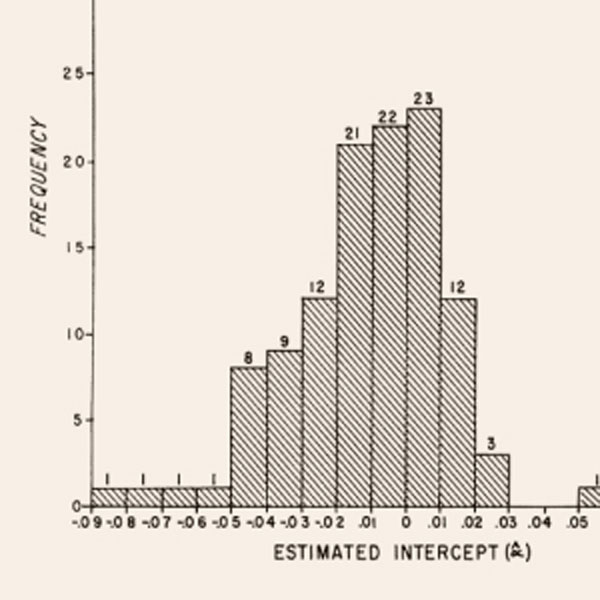
Michael Jensen, in the first major study of mutual funds, shows that active managers typically underperform an approach that owns all the stocks in the US market.
-
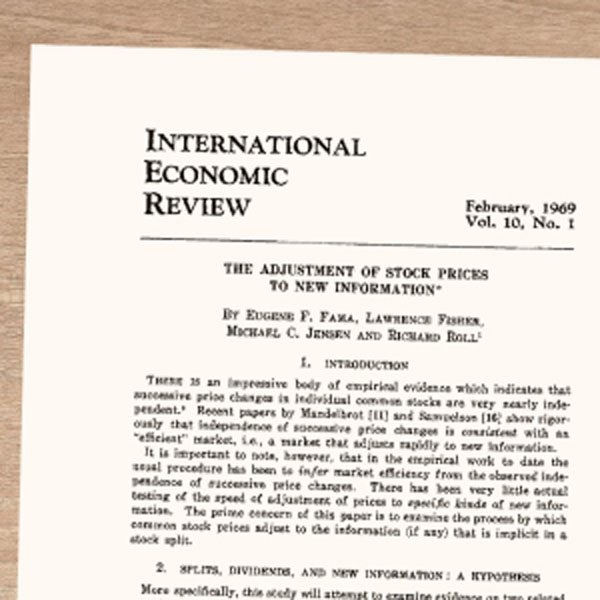
Fama, Lawrence Fisher, Jensen, and Richard Roll, in the first study of its kind, show that market prices adjust almost immediately to the expected impact of stock split announcements, lending considerable support to the concept of market efficiency.
-
David Booth enrolls as a PhD candidate at the University of Chicago Graduate School of Business, where he studies under Fama, the principal scholar whose groundbreaking work inspires Booth to found Dimensional in 1981.

-
-
1970
-
Eugene Fama publishes “Efficient Capital Markets: A Review of Theory and Empirical Work,” which offers the first comprehensive review of efficient markets research.

-
David Booth (pictured) joins John “Mac” McQuown at Wells Fargo Bank to help develop the first index portfolio.
McQuown became a founding member of Dimensional’s corporate board in 1981.

-
Rex Sinquefield graduates from the University of Chicago Graduate School of Business. A student of Fama’s and a self-described “efficient market fanatic,” Sinquefield co-founded Dimensional in 1981.

-
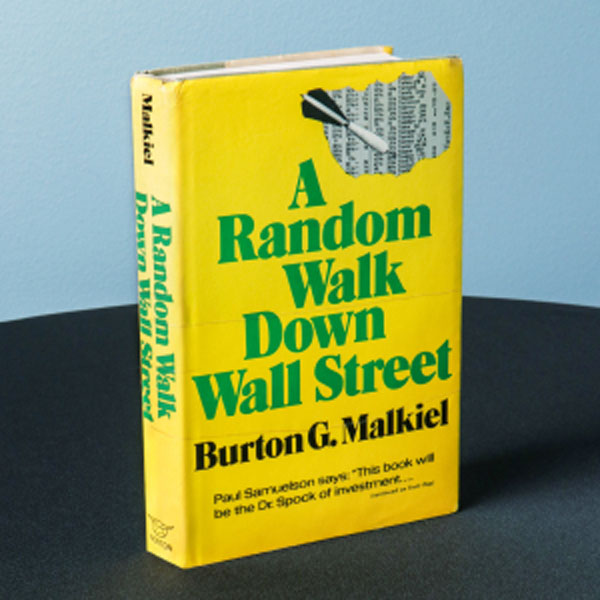
Burton G. Malkiel publishes A Random Walk Down Wall Street, popularizing the idea that no one can predict how stocks will perform and no stock-picking strategy can outperform buying and holding a diversified portfolio in the long run.
-
McQuown (pictured) and Booth at Wells Fargo and Sinquefield at American National Bank launch some of the first portfolios based on the S&P 500.

-
Fischer Black, Myron Scholes, and Robert Merton develop a unique options pricing model, which shows new ways to quantify the value of optionality and manage risk.
Scholes was a founding Independent Director of Dimensional’s US Mutual Funds Board and served in that role from 1981 to 2021. Merton served on Dimensional’s US Mutual Funds Board from 2003 to 2009.

-
Merton’s Intertemporal Capital Asset Pricing Model provides the theoretical framework for multifactor investing.

-
Fama’s paper “Forward Rates as Predictors of Future Spot Rates” establishes a foundation for a systematic approach to fixed income investing that incorporates information in current bond prices to help investors target higher expected returns.

-
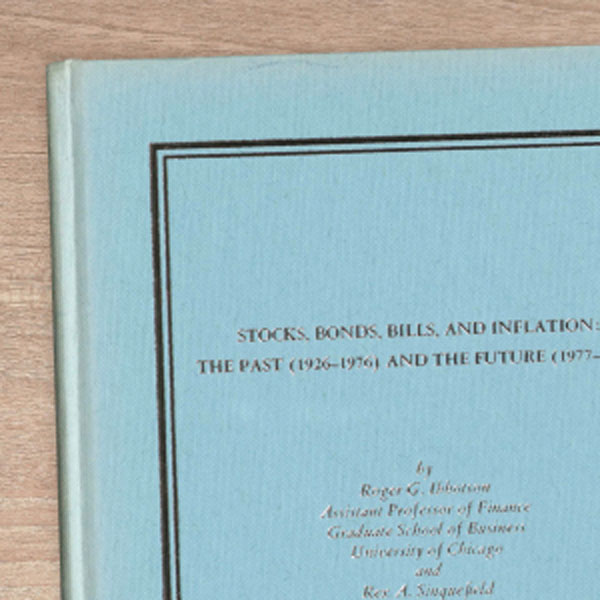
Roger Ibbotson and Sinquefield publish Stocks, Bonds, Bills, and Inflation, their influential study of major US asset class returns since 1926.
Ibbotson served for four decades as an Independent Director on the Boards of Dimensional’s US Mutual Funds and ETFs.
-
-
1980
-
Dimensional is founded from a spare bedroom in David Booth’s Brooklyn brownstone.

-
Dimensional launches the US Micro Cap Equity Strategy, which breaks new ground by offering small cap investing as a diversifier.

-
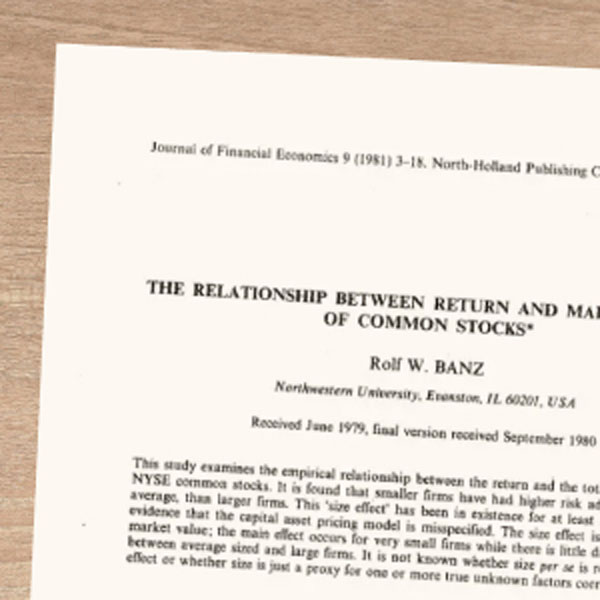
Rolf Banz’s research shows that small companies have higher expected returns.
-
Dimensional launches its first fixed income strategy, based on Eugene Fama’s pioneering research on interest rates and expected returns on bonds.
-
Dimensional launches its first international small cap strategies after sponsoring research on the size premium outside the US.

-
Dimensional establishes an office in London, the firm’s first location outside the US.

-
Fama and Robert Bliss, in “The Information in Long-Maturity Forward Rates,” show that variations in forward rates on bonds maturing in more than one year contain useful information about expected returns.

-
Building on a plan conceived by financial advisor Dan Wheeler, Dimensional opens fund access to qualified investment professionals, helping to launch an industry-wide movement toward conflict-free advice.
Wheeler joined Dimensional in 1989 and started the firm’s financial advisor business.

-
-
1990
-
Harry Markowitz, Merton Miller, and William Sharpe win the Nobel Prize in Economic Sciences for their pioneering work in the theory of financial economics.

-
Sharpe, in “The Arithmetic of Active Management,” shows that the aggregate of all investors is the market, so their performance is the market minus fees and expenses.

-
Eugene Fama and Ken French publish “The Cross-Section of Expected Stock Returns,” their pathbreaking paper pointing to company size and relative price as systematic drivers of equity returns. The results lay the groundwork for the launch of Dimensional’s value strategies.
French started working with Dimensional in the 1980s as a consultant and then as a Director on the corporate board.

-
Fama and French develop the three-factor model to explain the behavior of stock returns, and additionally show term and credit factors that explain most bond returns.

-
Dimensional launches its first value strategies: the US Large Cap Value Equity Strategy and US Small Cap Value Equity Strategy.

-
Dimensional opens an office in Sydney.

-
Robert Merton and Myron Scholes are named Nobel laureates for developing a new method to determine the value of derivatives.

-
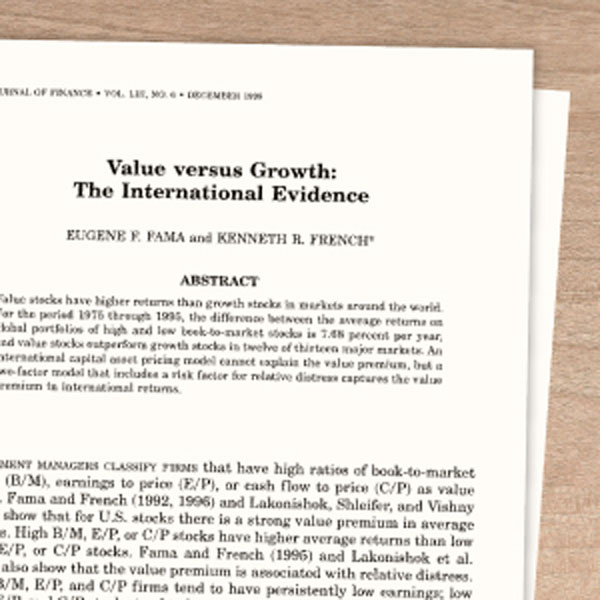
Fama and French show that value stocks have higher returns than growth stocks historically in international markets, a result published a year later in the Journal of Finance.
-
-
2000
-
Dimensional’s Vancouver office is opened.

-
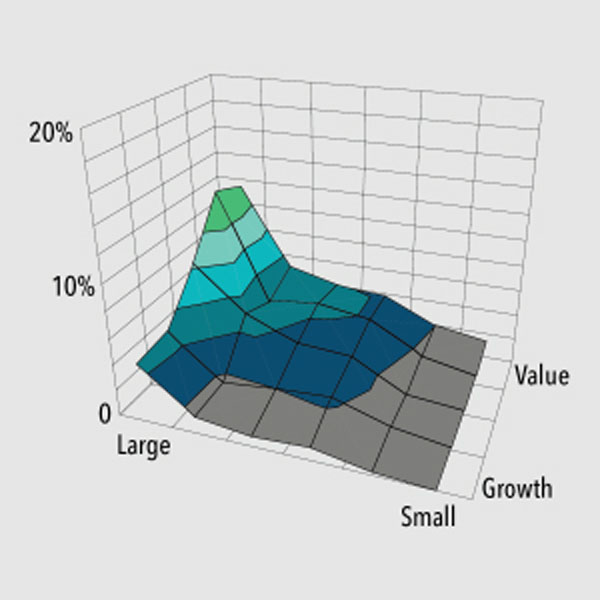
Dimensional develops a major advance in portfolio design known as core equity. It provides a single, diversified, marketwide solution focused on the drivers of higher expected returns.
-
Eugene Fama and Ken French confirm in research tests that company profitability and investment help predict stock returns. Robert Novy-Marx (not pictured) builds on these findings in 2013.
Novy-Marx became a consultant to Dimensional in 2014.

-
Alumnus David Booth makes a donation valued at $300 million to the University of Chicago Graduate School of Business, which is renamed the University of Chicago Booth School of Business.

-
Dimensional opens its Austin, Texas, headquarters.

-
Robert Merton joins Dimensional as Resident Scientist after serving on the Dimensional US Mutual Funds Board for six years.

-
Dimensional applies a variable credit approach to fixed income strategies based on earlier research by Fama and others showing that credit spreads provide information on expected credit premiums.

-
-
2010
-
Eugene Fama and Ken French, in the Journal of Finance article “Luck Versus Skill in the Cross-Section of Mutual Fund Returns,” find that mutual fund investors in aggregate realize net returns that underperform benchmarks by about the same amount as costs in expense ratios.

-
Dimensional grows its footprint in Europe, opening offices in Amsterdam and Berlin.
-
Robert Novy-Marx, in the Journal of Financial Economics paper “The Other Side of Value: The Gross Profitability Premium,” shows how company profitability helps explain differences in stock returns.

-
Building on the work by Novy-Marx, Dimensional’s Gerard O’Reilly and Savina Rizova find that high profitability stocks tend to outperform low profitability stocks across markets and through time. Dimensional begins incorporating this research, systematically targeting the profitability premium in equity strategies.

-
Fama wins the Nobel Prize in Economic Sciences for his empirical analysis of asset prices.

-
Dimensional’s presence in Asia Pacific grows, as the firm opens offices in Singapore, Tokyo and Melbourne. The Toronto office is also established, growing our footprint in Canada.
-
Fama and French find that a five-factor model designed to capture the equity, size, value, profitability, and investment premiums in average stock returns performs better than the three-factor model they introduced in 1993.

-
Dimensional launches US and international high relative profitability strategies.

-
Dimensional opens an office in Hong Kong.

-
After several academics as well as Dimensional’s Rizova and Namiko Saito show small companies that invest heavily tend to underperform, the firm begins excluding small cap firms with high asset growth from equity strategies.

-
Dimensional opens an office in Dublin.

-
-
2020
-
Dimensional’s Kaitlin Hendrix and Gavin Crabb show that temporarily refraining from buying small cap stocks with high borrowing costs can enhance investment outcomes.

-
Dimensional becomes the largest active U.S.-domiciled ETF issuer in the industry after launching exchange-traded funds in 2020.1

-
A fresh examination of credit variables by Dimensional’s Marlena Lee, Savina Rizova, and Samuel Wang confirms that the forward rate—a combination of a bond’s yield and its expected capital appreciation based on current prices—is the key metric to use when targeting higher expected returns in fixed income.

-
Chicago Booth professor Douglas Diamond, lead Independent Director of the Dimensional US Mutual Funds and ETFs Boards, receives the Nobel Prize in Economic Sciences for research on banks and financial crises.

-
Dimensional’s Wei Dai, Mamdouh Medhat, and Rizova, in research conducted with Robert Novy-Marx, show investors can benefit in their rebalancing process from accounting for short-run reversals in equity prices—the tendency for recent winners to underperform and recent losers to outperform over very short periods (one month, at most). The firm begins implementing this approach in 2024.

-
In “The Expected Returns of Agency MBS,” Dimensional’s Rizova, Wang, and Mingzhe Yi team with Zhaogang Song of Johns Hopkins to develop a framework linked to forward rates that can be used to target higher returns in mortgage-backed-securities strategies.

-
Dimensional’s Munich office is opened.

-
Dimensional’s Hendrix, Jerry Liu, and Trey Roberts, in “Measuring the Costs of Index Reconstitution: A 10-Year Perspective,” provide an up-to-date and broad evaluation of the reconstitution effect—the abnormally high trading volume and price pressure faced by index funds during index reconstitution events. The research cleanly identifies the cost of demanding immediacy when tracking an index.

-
Dimensional’s Hendrix, Jerry Liu, and Trey Roberts, in “Measuring the Costs of Index Reconstitution: Evidence Outside the US,” show that, globally, an investment approach forced to rebalance on an index’s reconstitution day may suffer from multiple sources of price pressure.

-
Dimensional’s global assets under management surpass $1 trillion (USD) for the first time in early February.2

-